
Published July 21, 2026 · Educational information — not legal, tax, lending, or financial advice.
Quick answer
A dispute is your legal right under the Fair Credit Reporting Act to challenge an entry if it contains factual errors. Collections can be disputed if they report the wrong amount, wrong account, duplicate entries, or outdated status. When you file a dispute, the bureau has 30 days to investigate; if the creditor cannot verify the account’s accuracy, the entry must be removed. The catch: accurate entries cannot be removed via dispute. A real debt that reports correctly stays on your file. If the collection is accurate, your options are different — a goodwill letter to the creditor, settlement negotiation, or letting time work (collections age off in roughly seven years from the original delinquency).
What makes a collection disputable
A collection entry is worth disputing if it contains factual errors — information that does not match what the original account actually shows. Examples include: wrong balance or amount, wrong dates (delinquency date, open date, collection date), account not yours, duplicate entries (the same account reported twice), furnisher name inaccuracy (a debt sold to a collector but reported under the original creditor’s name), or status errors (collection showing as unpaid when you paid it, or still reporting after the seven-year cutoff). Some collections result from identity theft; those are absolutely disputable. Others result from a creditor’s mistake — a merged account or a reporting error — and those too are fair game.
Accuracy vs. error: the core distinction
The single most important concept: disputes are only for errors, not for accurate entries you dislike. A real debt that reports correctly — real amount, real account, real dates, correct status — cannot be removed by disputing, no matter how hard you try. The entry might be aging you toward removal naturally, but disputing an accurate entry wastes the tool. If the collection is accurate, your options are dispute-adjacent but different: a goodwill letter (a courtesy request to the creditor), settlement negotiation, or letting the seven-year clock run. The reason this distinction matters is timing: if you spot an error, dispute it now while you have the legal tool. If the entry is accurate, pursue a different strategy.
How the dispute process works
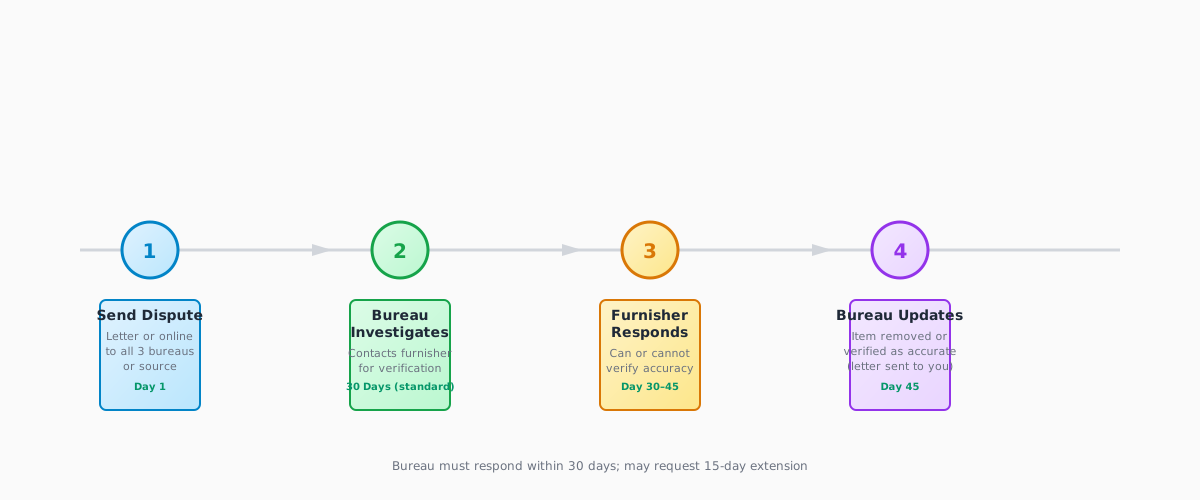
When you file a dispute with a credit bureau, you are asking the bureau to investigate whether the entry is accurate. The bureau then contacts the furnisher (the creditor or collection agency) and asks them to verify the account: the amount, the dates, the account number, whether it’s yours, and its current status. The furnisher has 30 days to respond. If they cannot verify the account’s accuracy — because records are missing, the debt was incorrect, or the account does not match their files — the entry must be deleted from all three credit reports. If they verify it as accurate, the entry stays. The bureau must send you a written notice of the results, and if an item was deleted, they must notify the other two bureaus so the entry comes off there too.
When removal is legally required
Removal is required when one of these conditions is true: (1) the furnisher cannot verify the account’s accuracy within the 30-day window, (2) the entry contains factual errors that the bureau confirms during investigation, or (3) the item has aged off the seven-year reporting timeline and should no longer appear (though you may need to point this out via dispute). Removal is not required when the entry is accurate. The law protects your right to dispute and to receive a fair investigation, but it does not require deletion of accurate information, no matter how old or how unwelcome.
Dispute vs. goodwill, validation, and negotiation
Several tools exist for dealing with collections, and they work on different mechanics. A dispute challenges accuracy; it is your legal right and requires no payment. Validation (a request under the FDCPA asking collectors to prove the debt is yours) is separate from a dispute, but serves a similar early-stage purpose: if a collector cannot validate, you may have grounds to file a dispute. A goodwill letter asks a creditor to remove an accurate entry as a courtesy — no legal right, but no cost either. Settlement negotiation involves offering payment in exchange for the creditor agreeing to update or remove the entry (get this in writing before paying). If you are certain the collection is inaccurate, start with dispute. If it is accurate but you want to resolve it, negotiate or send a goodwill letter. These are not mutually exclusive; a goodwill approach after a failed dispute is common.
Filing your dispute: step-by-step
Step 1 — Get your reports. First, obtain your credit reports from all three bureaus (Equifax, Experian, TransUnion). You can request free reports at annualcreditreport.com or ask for them in writing. Review each one carefully and identify the exact entry you want to dispute: the account name, the amount, the dates, and which bureau is reporting it. Some entries appear on all three; others on only one or two.
Step 2 — Identify the specific error. Pinpoint what is wrong. “This entry is unfair” is not an error. “The amount shows as $5,000 but the original account was $3,200” is. Be specific: dates, amounts, account details. The more precise you are, the easier the investigation.
Step 3 — File the dispute. You have three paths: (a) Online — many bureaus offer online dispute portals directly on their websites. (b) By mail — send a letter to the bureau stating your name, address, account number (if you have it), and the specific error, along with a copy of the report page showing the entry. Certified mail is recommended for proof. (c) By phone — call the bureau’s dispute line; they will record your dispute verbally. Online is fastest; mail creates a paper trail.
Step 4 — Document and track. Keep copies of everything: the dispute letter, the postmark or confirmation, and the report excerpt you submitted. Note the date you filed. You should receive a confirmation of receipt within a few business days. The bureau will provide a case number or reference ID.
Step 5 — Wait for investigation. The standard timeline is 30 days. The bureau investigates, the furnisher responds, and the bureau compiles results. You will receive written notice of what was found.
Document everything
Create a dispute file: keep the dispute letter or confirmation, the report pages, the case number, dates, and any correspondence from the bureau. If the entry is removed, request written confirmation for your records. If it remains, the bureau must send you a written explanation of why it was verified as accurate. These documents matter if you need to file again with new evidence, challenge the result, or pursue other remedies.
What to do after the bureau responds
If the entry was removed: Congratulations. Check all three reports in the next 30–45 days to confirm it is gone everywhere. If it reappears, file another dispute. If the bureau updated your report without removing the entry, review the changes; a status update (e.g., marking paid) might accomplish part of what you wanted.
If the entry was verified as accurate: The dispute process is complete; a second dispute on the same item without new evidence may be treated as frivolous. Your next move depends on the entry’s nature. If it is accurate, consider a goodwill letter, settlement negotiation, or pursuing the natural aging-off timeline. Some people also consult a consumer-law attorney if they believe the bureau’s investigation was unfair or incomplete.
If there are additional errors you spot later: You can file a new dispute specifically addressing those new findings. This is not a repeat; it is a fresh dispute with new evidence.
Key takeaways
- Disputes are for inaccuracies, not for accurate entries you dislike. Know the difference.
- If the furnisher cannot verify the account’s accuracy within 30 days, removal is required.
- Be specific about what is wrong: amounts, dates, account details. Vague complaints get nowhere.
- Document everything: keep copies of your dispute, confirmation numbers, and the written response.
- If the entry is verified as accurate, shift strategy: try a goodwill letter or settlement negotiation instead.
- Check all three reports after resolution to ensure the entry is gone everywhere, not just one bureau.