
Published July 21, 2026 · Educational information — not legal, tax, lending, or financial advice.
Quick answer
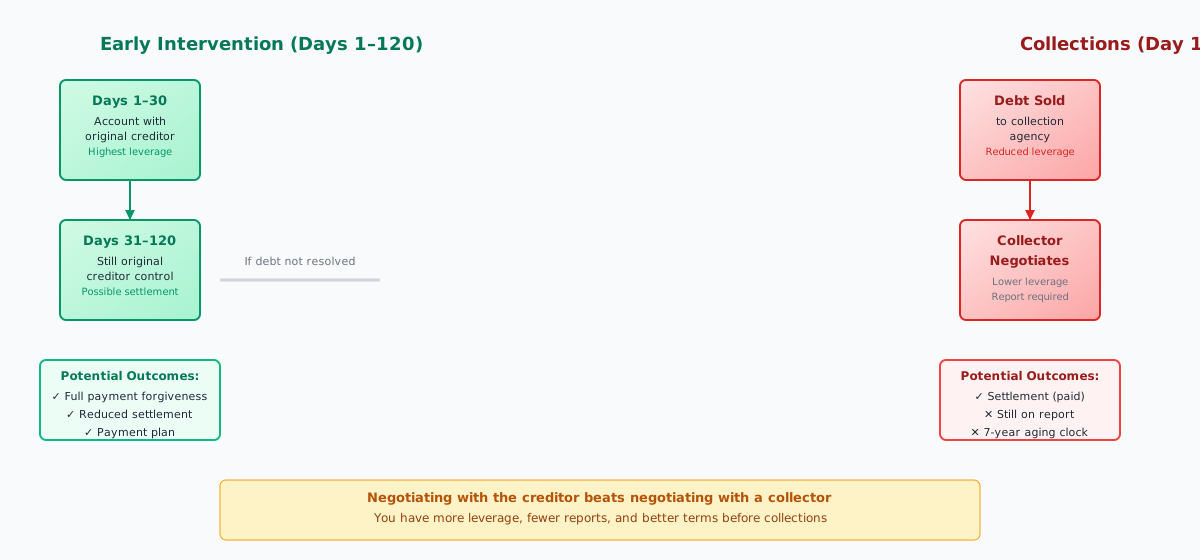
The window to negotiate with a creditor—before debt goes to collections—usually closes around day 120 of delinquency. In that window, you have leverage: the creditor wants to recover the balance without collections fees, and they have the authority to negotiate. After day 120, the account often sells to a collection agency, and your negotiating power drops. If you realize you cannot pay in full, contact the creditor immediately (ideally within the first 30 days) and ask what settlement options exist. Offer what you can afford (typically 40–70% of the balance as a starting point), but never pay without a written agreement stating the exact amount, payment terms, and what status they will report to your credit file. Getting terms in writing protects both of you and ensures you have proof of what was agreed.
Why early negotiation matters
The creditor who holds the account is highly motivated to recover money without collections. When a debt goes to a collector, the original creditor gets a fraction of the recovery (often 20–30%), has no further control over the account, and no ability to negotiate on your behalf. A collector has bought the account at a steep discount (often 50–80% off face value), so they have more room to negotiate, but they are also primarily incentivized to collect the full amount if possible. Your leverage is highest before the handoff. Once collections occurs, negotiating is still possible, but the terms tend to be less favorable, and the account already carries a collections mark that will age for seven years from the original delinquency.
The collection timeline and your window
Most creditors follow a predictable arc: Days 1–30: Account is noted as late, first contact attempts, creditor is most willing to work with you. Days 31–60: Account is escalated internally, creditor still has full authority to settle. Days 61–120: Creditor is evaluating whether to attempt further collection or prepare to sell the account. Day 120+: Account is typically sold or referred to a third-party collector, and the creditor loses authority to negotiate further. This timeline varies by creditor and account type (credit cards move faster, medical accounts sometimes slower), but the general arc holds: the sooner you reach out, the better your chances of settling on terms you can afford.
When to contact the creditor
Contact the creditor as soon as you realize you cannot pay the full balance on time. For most people, that realization hits somewhere between day 15 and day 60. Do not wait for the account to be reported as late, and do not ignore collection calls. Instead, when you receive a call or notice, take it as a signal to act. Call the creditor’s customer service or hardship department and ask to speak with someone in collections or dispute resolution. Be prepared to explain your situation in brief: What caused the hardship (job loss, illness, unexpected expense)? When do you expect to have cash available? Can you pay a portion now, or do you need time? This context helps the representative understand whether you are looking for a payment plan, a one-time settlement, or a temporary forbearance.
How to approach the conversation
Stay honest and calm. Representatives field calls from angry and desperate people all day; someone who is straightforward and calm stands out. Explain the situation plainly: “I had a job loss in May, and I have not been able to pay this account. I want to resolve it, and I can offer [amount] as a settlement if that works for your department.” Do not overpromise—if you say you can pay $500 and then cannot, it damages trust and may cost you the deal. Ask what options exist: “What settlement options are available?” or “What would it take to resolve this account?” The rep may offer a percentage, a lump-sum amount, or a payment plan. Listen, ask questions, and resist the urge to say yes immediately. Get the representative’s name, ID, and a reference number for the conversation. This matters if you need to follow up or dispute what was promised.
Making a settlement offer
Know your limit first. Before you call, decide what you can actually afford to pay without creating new hardship. If the account is $5,000 and you have $2,000 available, that is your realistic range. Starting with an offer that is clearly impossible (offering $500 on a $5,000 debt when you have no path to that amount later) wastes both your time and the rep’s. Offer a lump sum if possible. Creditors prefer one payment to the risk of a payment plan where you default mid-stream. A lump-sum settlement typically negotiates down to 40–70% of the balance, depending on how far delinquent the account is and the creditor’s recovery appetite. If you offer 50% and they ask for 60%, you have room to negotiate. Be specific about timing. “I can pay $2,500 on Friday” is stronger than “I can pay eventually.” Creditors are willing to move fast if they think the money is imminent. If a payment plan is your only option, ask for a short, manageable schedule: 3–6 months is more credible than 24 months. Long payment plans carry high default risk, and creditors know it.
Getting it in writing
This is non-negotiable: do not send any money until you have a written settlement agreement. Here’s why: a verbal agreement is not binding, creditors change hands, representatives leave, and your word-of-mouth commitment is suddenly worthless. A written agreement specifies—and protects you by documenting:
- The exact settlement amount: e.g., "$2,500 resolves this account in full."
- The payment date and method: "Payment due [date], via [wire / check / ACH]."
- The reporting status: What will the creditor report after payment? "Settled," "Paid in full," "Paid as agreed"? Each has slightly different reporting implications. Push for "Paid in full" if possible; accept "Settled" if needed.
- Any removal clauses (if negotiated): Some creditors will agree to remove the account from your report after settlement; this is rare but worth asking for and getting in writing if offered.
- Your contact and account information: Name, account number, current balance, and how the creditor confirms receipt.
Request the agreement in writing via email or letter. Ask the representative to email it to you, or offer to send a summary email ("Per our conversation, we agreed to [terms]—please reply to confirm") and ask them to reply confirming. If the creditor is unwilling to document the agreement, that is a red flag. A creditor confident in their commitment will put it in writing. If they refuse, ask to speak with a supervisor.
Payment safety and verification
Once you have the written agreement, verify one more time that you are sending payment to the creditor, not to a third party or unknown account. Never wire money to an account you cannot independently verify. Call the creditor's main customer service line (using a number from your statement or the creditor's official website, not from an email or text) and confirm the payment instructions. After you send payment, follow up in writing to the address on the agreement, noting the payment method, date, and amount. Keep all receipts, confirmation numbers, and correspondence. The settlement does not complete until the creditor confirms receipt and applies the payment.
What to do after settlement
Verify the account status in 30–45 days. Check your credit reports to ensure the creditor updated the account as agreed. The status should reflect "settled" or "paid," not "unpaid" or "delinquent." If the status is wrong, contact the creditor with your written agreement and ask them to correct it. Request written confirmation of the correction. Keep your documentation. Save the settlement agreement, payment receipts, and all correspondence with the creditor indefinitely. If a question arises later (e.g., the collector tries to collect on the same debt), your documentation proves the settlement and protects you. If the creditor does not update the account as promised, document the failure and contact them again. If they still refuse, you have grounds to file a complaint with the Consumer Financial Protection Bureau (CFPB), which oversees creditor and collector behavior.
Early creditor negotiation vs. late collector negotiation
If you miss the 120-day window and the debt goes to a collector, settlement is still possible—but the dynamic changes. Collectors buy accounts at deep discounts, so they have more room to settle. However, the account now reports under the collector’s name, the delinquency is already on your report, and the collector’s primary incentive is not customer relationships but recovery at any price. You retain the same rights: you can dispute inaccuracies, request validation under the FDCPA, and negotiate settlement. But your negotiating position is weaker, and your outcomes are constrained by the fact that the account is already in collections. For details on post-collections negotiation, see should you pay off a collection account.
Key takeaways
- Act early. Your leverage is highest in the first 30–120 days before the account goes to collections.
- Only offer what you can afford to pay. A credible offer based on your actual cash flow is more likely to succeed than an aspirational one.
- Lump-sum settlements often negotiate lower than payment plans. If you have the cash available, that is your strongest position.
- Never pay without a written agreement. Verbal commitments evaporate; written ones protect you and the creditor.
- Verify payment instructions directly with the creditor's official number, not email or text.
- Check your reports 30–45 days after payment to confirm the account status was updated as agreed.