
Published July 6, 2026 · Educational information — not legal, tax, lending, or financial advice.
Quick answer
Federal law gives you the right to dispute anything inaccurate on your credit reports, free, with no company required. The process: identify the exact item, gather documents that prove the error, and file with each bureau showing it — online for speed, or by mail for the strongest paper trail. The bureau investigates with the furnisher, generally within about 30 days, and must correct or remove anything inaccurate or unverifiable. A strong dispute names the item precisely, states specifically why it’s wrong, attaches evidence, and makes a clear ask. Disputes fix errors — accurate negative history generally stays for its reporting period, no matter who disputes it. If a wrong item comes back “verified,” you still have moves: re-dispute with better evidence, go direct to the furnisher, or escalate to the CFPB.
What counts as a disputable error?
The dispute process exists for information that is inaccurate, incomplete, outdated, or unverifiable. The common catches: late marks on months you paid on time, wrong balances or credit limits (a stale limit quietly inflates your utilization), accounts showing open that you closed or the reverse, someone else’s account mixed into your file, the same debt reported by two collectors simultaneously, and negative items still reporting past their removal window — the seven-year clocks for late payments and collections being the usual reference points.
Finding these is a reading exercise before it’s a disputing exercise; the section-by-section verify list is in how to read your credit report. One routing rule up front: an account that isn’t yours at all isn’t an ordinary error — it’s fraud, and it gets the stronger identity-theft path in what to do if someone opens an account in your name. The same logic applies to a hard inquiry from an application you never made — that one has its own dedicated walkthrough in how to remove unauthorized hard inquiries from your credit report.
Before you file: evidence first
Disputes are decided on documentation, so gather it before filing rather than after a rejection. Match the evidence to the claim: a bank statement or payment confirmation for a wrong late mark; a card statement showing the real limit for a utilization-distorting error; the closure confirmation letter for an account showing open; dates and account numbers for a duplicate collection. Pull all three bureau reports first — the bureaus keep separate files, so the error may live on one, two, or all three, and you’ll file wherever it appears; that separate-files reality is the same one behind why your three credit scores are different. Send copies, never originals, and keep everything: the dispute file you build now is what makes any second round short.
Filing: online, mail, or phone
Each bureau accepts disputes three ways, and the choice is a speed-versus-paper-trail tradeoff. Online is fastest and fine for straightforward errors — portals walk you through item selection and let you upload documents. Mail is the heavyweight option: a letter lets you frame the error exactly, attach full documentation, keep a dated copy, and send with delivery confirmation, which matters if the dispute ever becomes a fight. Phone exists but leaves the weakest record. Whichever channel, file with every bureau showing the error — they don’t share outcomes, so one correction doesn’t propagate. And where the error originated with a lender or collector, you can also dispute directly with that furnisher, which sometimes fixes the source faster than the bureau route; the two paths run independently and can run in parallel.
What a strong dispute includes
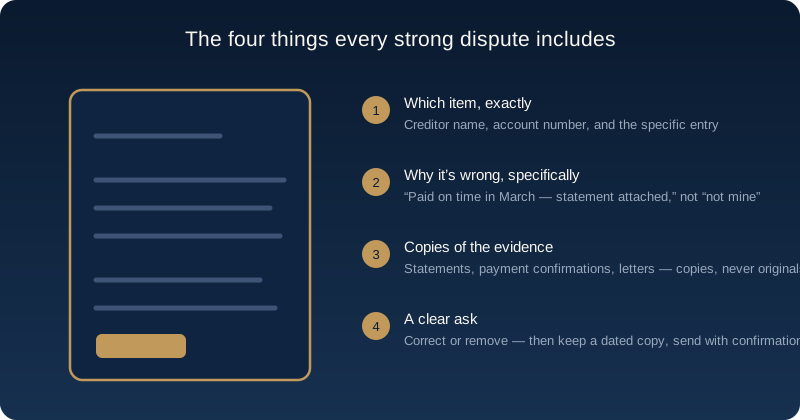
Weak disputes are vague; strong ones are surgical. Four elements: (1) the exact item — creditor name, account number, and which entry on which report; (2) the specific defect — “the March 2025 payment is marked 30 days late; the attached statement shows it posted March 3rd,” not “this is wrong” or a blanket “not mine” across a dozen items; (3) copies of the evidence, labeled so a stranger can follow them; (4) a clear ask — correct the entry or remove it. Precision does two jobs: it makes the furnisher’s verification actually engage with your evidence, and it keeps your dispute out of the pile that gets dismissed as frivolous — a real risk with template blasts that dispute everything on a file indiscriminately. One well-built dispute beats ten vague ones.
What happens after you file?
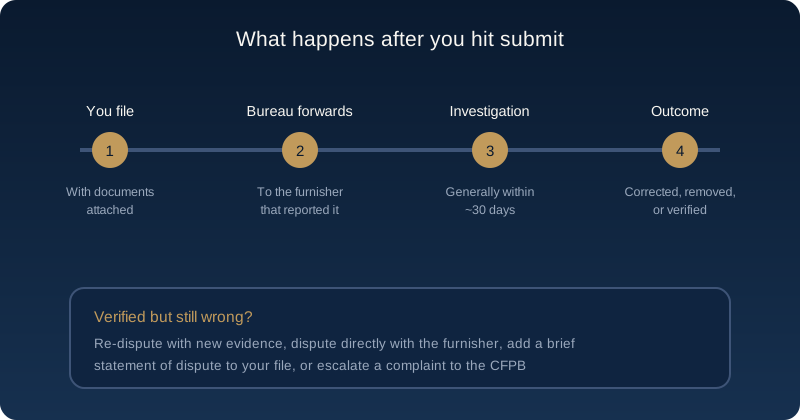
Once filed, the bureau forwards your dispute and evidence to the furnisher that reported the information, which must investigate and respond; the whole cycle generally completes within about 30 days (sometimes 45 if you add documents mid-stream).
Three outcomes: corrected (the entry is fixed), removed (the furnisher couldn’t verify it — unverifiable information must come off), or verified (the furnisher stands by the data). You get written results, plus a free updated copy of your report when something changes. Filing a dispute doesn’t hurt your score; a successful one can help it, because the score is computed from the file and the file just improved. Confirm the fix on fresh copies of every report that showed the error — and diarize a re-check a couple months later, since corrected items occasionally get re-reported by sloppy furnishers.
Verified but still wrong: next moves
“Verified” means the furnisher confirmed its own records — it doesn’t make wrong data right, and it isn’t the end of the road.
Four moves remain, roughly in order: re-dispute with new evidence — a repeat of the identical dispute can be dismissed, but fresh documentation restarts a real investigation; dispute directly with the furnisher in writing, which puts the accuracy obligation on the party whose records are wrong; add a statement of dispute to your file — a brief note visible to future report viewers, useful as a flag even though automated scoring ignores it; and file a CFPB complaint, which routes to the bureau or furnisher with a required response and a regulator watching. Persistence with paper wins these more often than volume does — which is why the dated copies and delivery confirmations from round one matter.
What disputes can’t do
The dispute process corrects the record; it doesn’t rewrite history. Accurate, timely, verifiable negative information — a late payment that really happened, a legitimate collection within its seven-year window — generally stays for its full reporting period regardless of how many disputes are filed or who files them. No credit repair company has rights you lack — the full comparison is in do you need a credit repair company: anything they can lawfully dispute, you can dispute yourself, free. Claims of guaranteed removals of accurate items are the industry’s oldest red flag. The honest playbook for accurate negatives is time plus new behavior: negative items age off on schedule while on-time payments and lower balances build the positive side — and the dispute tool stays in the drawer for what it’s actually for.
Two real-world examples
The misapplied payment. Keisha’s report shows a 30-day late on her auto loan for a month she paid. Her bank records show the payment cleared on the 2nd — the lender applied it to the wrong account internally. She disputes online at the two bureaus showing the mark, uploading the bank statement and a screenshot of the loan’s own payment history, and simultaneously mails the lender a direct dispute. The lender corrects its records in week three; both bureau disputes come back “corrected” days later. Her score recovers the points the late mark had cost — not as a favor, but because the data feeding the score changed.
The verified duplicate. Ray’s report shows the same old utility debt twice — original collector and the agency it was sold to, both with active balances. His first online dispute comes back “verified” on both entries. Instead of refiling the same claim, he builds a better one: a mailed dispute with both entries’ account numbers, the sale date, and a letter from the current collector confirming it now owns the debt — proof the first entry should show zero and transferred. He sends it with delivery confirmation to the two bureaus showing the duplicate, and copies the original collector directly. Round two removes the stale entry at both bureaus inside a month. Same facts as round one; the difference was evidence that engaged.
Key takeaways
- Disputing is free, federal, and requires no company — file with every bureau showing the error, since outcomes don’t propagate.
- Strong disputes are surgical: exact item, specific reason, attached evidence, clear ask — vague blasts get dismissed.
- Investigations generally resolve in ~30 days: corrected, removed, or verified — and unverifiable information must come off.
- “Verified” isn’t a wall: re-dispute with new evidence, go direct to the furnisher, add a statement, or escalate to the CFPB.
- Disputes fix errors, not history — accurate negatives age off on schedule while new behavior builds the positive side.